About Me

My photo
I'm a bit of a born-again wargamer! I played many of the Games Workshop games when I was in my teens and early twenties, but left the hobby behind when I went to University. Over the last few years I have gradually got back into it and am literally having a ball! I'll play pretty much anything now, ranging from ancient historical to the far future! I think that I get more out of the painting side of things than actually playing, but that might just be because I get more opportunity. Hence the title...this blog is all about the colour of war!!

Sunday, 16 January 2011

Why everyone should have some modelling putty lying about

Typical! After just singing the praises of Magister Militum I broke open the next pack of gladius wielding world conquerors to find that some of the Republic's equipement suppliers are letting their standards slip:


If there's one thing I hate more than flash and mould lines is a miscast figure like this! And it's not like it's somthing you can easily ignore...half the shield is missing! So I decided to break out the greenstuff and try to remedy the situation! I could have used Miliput, but I thought this would be a good opportunity to get a bit of practice with the GS:


It's not the smoothest of finishes, but it should be good enough! I'll maybe keep track of this guy as I paint him and see just how well he integrates!

Friday, 14 January 2011

Polybian Romans - Essex vs Magister Militum

For about a month or so I had 4 bases of primed Magister Militum (MM) Republican Romans sitting about my painting area and really just getting in the way. Once I finished the gladiators I decided to just slap some paint on them and get them out of the way, but as I started I soon found out that these wee figures really, really take paint well! In all honesty I wasn't trying to be particularly neat and tidy and was painting faster than I normally do, but they seemed to come out really nicely!


When I originally decided to do 15mm ancients I didn't really know which manufacturers were out there, but I had seen Magister Militum at Claymore and was highly impressed with the quality, so it seemed pretty straightforward to buy from them and I ordered the equivalent of a couple of FoG battlegroups (in mixed poses and with both pila and gladius) to get started. I was pretty happy with the figures, but they got shelved as something else came up. I then spied an Essex Roman DBA army on eBay and got it quite cheaply and endeavoured to paint it all up (as seen on this blog before). Once I'd seen the finely detailed Essex figures I thought the MM looked a little rough around the edges, but painting really brought them to life. So, I thought I'd take some comparison pics to illustrate the differences and maybe help anyone thinking of using these manufacturers to decide which they like best.

First off, the Hastati. The most obvious differences here are the different stance and the lack of a bronze plate on the back of the MM. The plumes on the helmet are also somewhat different and the shields are slightly different, but not by much. On close inspection, the MM are beefier than the Essex and would actually stand a bit taller if it weren't for the more dynamic pose, but from arms length they mix with no problems at all.

Essex on the left and MM on the right

Essex still on the left

This shot shows the tunics off quite well

Next are the Principes. These are the figures that are the most similar to look at from a distance. When you get a bit closer, though, I think the mail looks more finely detailed and regular on the Essex than the MM, which is what drew me to the conclusion that MM were a bit rougher round the edges than the Essex. Also the tunic and mail are a bit shorter on the MM, but the shields are again quite compatible despite the MM being a bit more oval. Both sets model the Montefortino helmet quite closely to the pictures I've seen, but again, the MM have higher, more impressive feathers on the crest. As with the Hastati, the MM are bulkier then the Essex, but will mix and match OK on the tabletop. I suppose that comes as no surprise!

Just to mess with you the MM are on the left in these pics

This angle shows how the Principes will mix well

This angle shows the difference in texture of the mail. The Essex are a
bit dull, though, due to slightly too liberal application of matt varnish!

My personal preference for the Hastati lies with the MM due to the more action-like pose and the lack of the back-plate which shows off the tunic a bit more, but that is not to say I suddenly dislike the Essex. The Principes I am less inclined towards a preference due the similarities, but I think the MM slightly win out due the pose and the somewhat more imposing crests. If I had to only buy one of these ranges I would probably go with MM, but I think Essex are maybe a shade cheaper and are by no means a poor alternative. Also, Essex often have 3 for 2 sales on DBA armies. The ratio of troop types in a DBA army mean that this would be a very cheap way of putting together a core force and is how I gained at least half of the legionaries I have!

Sunday, 9 January 2011

We salute you...!

So I've just managed to finish my first painted figures of 2011 and thought I'd share them. These are a Murmillo and Hoplomachus gladiator from Crusader. My WWII Brits and Fallschirmjager are Crusader as well and I really like their figures. For the Murmillo, I think that's the first shield I've painted since I played Warhammer in the 90s so I blatantly plagiarised a shield from a Murmillo on the Crusader website! :) I think it looks pretty good, though. For the Hoplomachus I was torn between going for bronze or iron for the shield, but I knew I wanted the face plate to be iron, so I thought an iron shield would tie up all the iron rather than having bits of bronze and iron here and there which might look a bit fussy. So the bronze helmet and greaves nicely frame the figure with all the metal in between being iron. I think I made the iron a bit too bright, though, so I might go back and darken it down a bit.

The flesh is also a bit of a departure for me. I normall use GW Dwarf Flesh with a wash of Devlan Mud and then highlighted with Elf Flesh and that works fine for faces and hands, but we have a bit more on show here! So I thought I'd try just painting it. I originally picked a triad from the Cool Mini Or Not ethnic skintone guide but found the contrast a bit too much, so I just added a bit of Vallejo Chocolate Brown to Cork Brown for the base, Cork Brown for mid tone and Cork Brown with some Flat Flesh for the highlight.

Murmillo


Hoplomachus


Hope you like them!

Wednesday, 5 January 2011

Wargames in a box

First off.. Happy New Year! Right, now that's out the way onto the gaming! :)

My first buy of 2011 was a semi-impulse purchase of Battle Cry (an American Civil War version of the Commands and Colours game system). I noticed it at a local comic/toy shop and thought 'oooh...should I buy that?'! I left it, though, and went home. At that point I decided I did want it so went back the next day and got it. It's no secret that I like games that are easy and quick to set up (and by that I mean assembling and painting figures and terrain) which is one of the main reasons I like Commands and Colours Ancients (CC:A), so Battle Cry seemed like a reasonable addition to the collection. In particular, I like the portability of the CC games which are, literally, wargames in a box! Most people's initial impression of the CC games is probably that it's a board game, but it really isn't. The system was designed for miniatures but for some reason it's produced as a board game rather that a paper rule set with various supplements.

So, with CC:Napoleonics pretty much on everyone's radar at the moment I thought I'd do a quick comparison of Battle Cry (BC) with CC:A. The box I got was the 150th Anniversary of the Civil War edition which is not, I believe, just a reprint, but includes some tweaks and all the scenarios from the original game plus supplements, so that's a meaty 30 scenarios in all compared to 15 in CC:A.

Contents/Price
First off, the actual production of BC is nothing short of lavish. The board is good quality and sturdy, the cards are nice and glossy as is the rule book (which contains the scenarios). The hex terrain tiles and various counters are all made from heavy card and the plastic figures are nicely detailed. The box comes with a plastic tray insert with compartments for all the various tiles, cards, dice, tokens and figures which is very appreciated. Contrast that with CC:A which came with no tray which means all the terrain tiles, cards, dice and blocks are all loose (all my blocks are segregated in zip-lock freezer bags, which I thought absolutely necessary if you want to set up a game in less than half an hour!). Finally, the dice in BC are properly engraved, nicely-sized dice and not just cubes you have to put stickers on. The dice in CC:A are my biggest bug-bear with the game...they're massive, clunky things!! Given that I picked up BC for £45 which is actually cheaper than I picked up CC:A for, then BC wins by a mile!


The Mechanics
The first section there is more of a comparison between different companies productions (Avalon Hill/Wizards of the Coast for BC and GMT Games for CC:A). The game mechanics themselves are very similar, unsurprisingly. However, BC is a actually a lot less complex than CC:A. In BC you have three troop types -infantry, artillery and cavalry. In CC:A there are also infantry and cavalry, but they are graded as Heavy, Medium and Light and that is what you are trying to throw against.
Also, in BC, the generals are a lot less important and do not have a symbol on the dice. They simply allow a retreat to be ignored and allow activation of attached units on leadership cards (usually with an extra dice in combat). In CC:A they have all those benefits plus a distinct effect on combat with leader symbols on the dice hitting for any units attached or adjacent.
Next is the major difference in the games - firepower, of course! In CC:A, light infantry can fire a couple of hexes (three for bows) and generally do little damage, as only unit symbols and flags count. In BC, infantry get 4 dice and lose 1 for each hex past the first to the target (so 4 at a unit in adjacent hex, 1 at one 4 hexes away). Artillery get 5. Cavalry get 3 but must be adjacent to attack (at first I was surprised at cavalry having to be adjacent as it felt like melee but they weren't generally used in the mounted, sabre-wielding role, but you can rationalise the short range as representative of the smaller numbers in a regiment, plus the fact that a portion have to hold the horses).  So firepower degrades nicely over range. This feels pretty good.
Associated with the firepower is the lethality of attacks. With the absence of a leader symbol on the dice it means there is a face going spare and it has been filled with another infantry symbol. Given that crossed swords always hit in BC it means that, against infantry, every dice has a 50% chance of hitting. In CC:A there is only one symbol for each grading and swords only hit for Medium and above, so the light infantry are really there to harass and it's the Mediums and Heavies that are the killing machines. The addition of a leader means you can achieve a 50% for each dice, but on the whole it's easier to get hits in BC than in CC:A.


Gameplay
I always thought that CC:A is a very simple game that you can teach a new player in minutes (and I mean that!), so I was interested to see just how an even simpler version would play as well as the obvious difference in warfare. I have to say I was not disappointed! In CC:A it's very much about getting your battle lines organised and into the enemy. Victory flags are mostly won through getting light troops behind targets and getting the heavies into the fight as soon as possible. BC felt completely different. Getting close to the enemy, especially one in terrain or dug in, is suicidal unless you're very confident of winning in one go, and artillery can really close off avenues of attack. I found that troops were generally moving into terrain a lot more (and the scenarios tend to have a lot more terrain, understandably) and blasting away at each other until the opportunity for a bayonet charge presented itself. So terrain becomes incredibly important, infantry are much more lethal, but are in turn killed a lot more easily. Throw in trenches and earthworks and all the flavour of the ACW is there!


Conclusion
Commands and Colours as a game system is simply brilliant! The same easy mechanics, with some simple tweaks, can satisfactorily (at least for me) represent warfare as widely different as Rome going head to head with Carthage and the ACW, which is really the first glimpse at modern warfare! As mentioned, CC:N is grabbing all the headlines at the moment, but I would heartily recommend Battle Cry to anyone as a fun, easy and quick game that really does play like a miniatures game and captures the flavour of the period. Of course, ditto to CC:A! It sort of feels like I'm criticising CC:A here, but I'm really not. I still love that game and would probably love Memoir '44 and CC:N if I ever got them! However, I have Napoleonic and WWII minis so I can get my fix that way. CC:A and BC really do fill a hole in my gaming spectrum, though, which is another reason why I'd urge people to consider them...they're a really cheap and accessible way of getting into period you don't currently have the minis for!

Friday, 31 December 2010

History nearly repeats itself

Corunna, 1809

Last night I enjoyed the last game of 2010 and a very good one it was. Having furiously painted hundreds of 6mm Baccus figures over the last couple of months we were all set to play the Corunna scenario from the Polemos Napoleonic Companion using Polemos General De Division rules. Carl took the part of Sir John Moore and I was Soult. James and I then split the French divisions between us with myself taking the right and James the left. The deployment was a curving line of British with Fraser (all trained) on the far right, then Baird and Hope (both veteran divisions) completing the line, with Paget (trained) somewhat in reserve and in position to plug the gap between Baird and Fraser. The French right was taken by Lorges and Delaborde, with Merle in the middle. James' command was Mermet beside Merle and Lahoussaye and Franceschi completing the cavalry left flank. All the French were rated as trained.

Looking from the British right / French left. I didn't have time to paint the general figures, so I just painted the bases red and blue and wrote the name and drew the NATO troop type symbol on them. Worked just fine!
The first few turns saw Delaborde and Lorges occupy the village Piedralonga to their front. Merle was to advance to Elvina (the big town in the middle) and Mermet to San Cristobal (nearest in the picture above). Our plan was to move the left cavalry divisions up to pin Fraser in place and move Merle up to keep Baird occupied while Mermet hooked around San Cristobal and into Baird's flank, or Paget if he moved up.

Merle and Mermet move off

Merle approaches Baird while Mermet moves through San Cristobal. The cavalry start to move up to occupy Fraser's attention.

The situation in the centre develops.
So far the French artillery was harrassing the British lines causing the occasional shaken result, but Carl always had his generals and C-in-C on hand to rally them. It was around this point that history nearly repeated itself when Moore was struck while the battalion he was with was under artillery fire. However, the dice gods favoured the British in this battle and Moore only suffered a flesh wound rather than a mortal one. So now the stage was set for the action to start. Mermet's approach towards the joint between Baird and Paget was causing Carl some concern, so he moved Paget up to plug the gap, as I had hoped he would do. I fancied the chances of Merle against Paget's trained troops more than Baird's veterans! So far Carl had been winning the initiative every turn because he could afford to bid almost all his tempo points as he was largely static, but he got a bit comfortable with always going first and his face was an absolute picture when I outbid him for the first time to grab the initiative and gave James the tempo point to get Mermet into Paget before he could respond. Alas, we had made our first mistake a couple of turns earlier, though. Merle deployed his division into mixed order and blocked off one of Mermet's brigades and we decided to just leave it there as reserve while the other two attacked Paget.

Mistake! One of Mermet's brigades is left behind!
And crisis point was acheived! Mermet's two brigades cried 'Vive l'empereur!" and charged! One of Paget's battalions was shaken and fell back into the rear brigade shaking them, but crucially the right hand brigade received a devastating volley and the head of the column disintegrated and the whole brigade fell back in disarray. Unfortunately for us, James rolled badly for the morale and the French troops decided that they weren't really that up for this fight! A wee bit like the real battle! :) However, this did leave the victorious French brigade to attack the flank of the battalion that had sent their counterparts reeling and another initiative win let us do just that! The brigade charged in and this time the British broke and fled. Crucially, though, the stalwart British brigades passed every morale check required and the division survived to regroup.

Mermet attacks and breaks Paget's formation up, but one French brigade is repelled and subsequently retires.

Mermet's victorious brigade follows up, breaks a battalion but Paget retires in good order and reforms. Further up Merle has advanced towards Baird.
As displayed above, while all this was going on, Merle advanced towards Baird, Lorges was menacing Hope and the two cavalry divisions on the left were making sure Fraser was going nowhere! At this point it was all in the balance. Paget was battered and driven back, but not broken. Mermet had lost a brigade but had one in a very advantagous position. We decided that Paget was not the best target so Mermet wheeled his brigade to attack Baird's flank and try to coordinate with Merle.


Mermet wheels into Baird's flank and Merle lets off a volley to try and shake the British with some success.
 But, as I said, the dice gods favoured the British that night! Mermet's brigade charged in but were halted by a murderous volley from the British and had to fall back, one battalion fleeing. This left them vulnerable to a countercharge by Paget which broke the whole brigade (again James failed every morale roll) and Mermet decided his division could do no more and retired from the field.

Paget sees off Mermet!
Baird took this moment to call his veteran division into action and charge home against Mermet. The French musketry was nowhere near as effective, but the division survived the attack but not without plenty of shaken levels and falling back. I managed to clear some shaken levels with Soult and Merle moving up personally and then counterattacked with the flanking brigades in column. The British volleys were telling though and the French had to fall back again. We had already established that the French weren't up to the fight and I duly failed a morale check and one brigade was spent. Time was running out at this point and the British were looking very strong still having only had one battalion broken for four French brigades! So we called it a day and a resounding British victory.

I think that the scenario as a whole is a pretty difficult one for the French to win as half the Brirish army is rated as veteran which makes them a very tough nut to crack without overwhelming numerical superiority which the French don't really have. I already mentioned our first mistake, which was leaving one brigade back which could have been decisive had it been in the attack, but I think we made another which was to not use the left flank cavalry a bit better. I think that one division would have been sufficient to prevent Fraser getting too involved and perhaps we could have comitted Lahoussaye into a combined attack against Paget with Mermet. I think that would have resulted in total destruction of Paget's division, but then...hindsight is 20/20!! As it stands, it was a fun enjoyable battle that could have gone either way at one point, but it generally went with history and the stout British thwarted what I think was a reasonable plan, just executed by an unenthusiastic French corps. Now...if only Napoleon hadn't buggered off back to Paris!!!

Monday, 20 December 2010

A year of blogging

I know, it's been ages, but I've not really had much to blog about! November was a very quiet month for gaming with the snow and everything and I have pretty much only been painting 6mm Napoleonic figures for a big game just before New Year (we're going to use the Polemos rules to play the Corunna scenario from the companion volume). I toyed with the idea of doing a step-by-step to illustrate just how easy it is to get a nice result but I just didn't get the time. Too many bases to get through in a reasonably short time (well, for someone with 2 young children, anyway!). However, I'm nearly there and that means I can start looking at what projects are looming in 2011.

First off, my brother is getting me some Gladiators for xmas and I can't wait to get my hands on them and start painting 28mm figures again! The 6mm stuff is nice and fast and the mass effect is lovely, but the actual painting of individual figures is nowhere near as rewarding as 28mm. Plus I have a copy of Morituri Te Salutant that I have read and am itching to try out. I'm a big fan of games like MTS that are quick to play, yet tactical, and only need a few figures and minimal terrain as it allows you to add variety to the games available quickly and cheaply. I think that's certainly a major factor in why I like CY6! Once you have the mat and stands, all you need are a handful of planes for whatever period you want.

Secondly, the zombies are coming to get you!! :) Having recently watched the Walking Dead I was inspired to get All Things Zombie and a bunch of Rebel Minis 15mm zombies, so I'm just waiting for them to arrive from the US. Not only do I think that this game will be a lot of fun, but it's perfect for solo play and it will be very suitable for the Friday games with James and Carl, as we can play coop, rather than versus. With only 3 players a coop game will be ideal.

Thirdly, the club usually puts on a Hordes of the Things tournament early each year, so I took some time to plan my army for that and acquire the figures, so I'll need to paint them soon. I won't say what they are yet...you'll have to wait and see!

Lastly, there are a couple of anniversaries coming up that hold some interest for me. First is Crete in May, which we have already seen some figures for, but not much else! Second is Albuera which is a Napoleonic battle that always fascinated me. It's one of the few major battles that Wellington didn't command at and it also is one of the few that the Spanish gave a credible performance at. Also, it was the first appearance of the Vistula Lancers in a major battle (or so I believe), soon to be the Lancers of the Imperial Guard, and I always had a wee thing for their uniforms! :)

So, in short, next year looks to be a colourful one and I do hope to get some photos of the Corunna game and maybe some shots of the armies before the New Year. So until then...!

Wednesday, 3 November 2010

The Battle ends as the Blitz begins

Last night saw the final instalment of the Battle of Britain campaign I've been running at the club. The first Tuesday of the month is traditionally given over to a multiplayer campaign game in which all club members are free to turn up and participate and, as it is the 70th anniversary of the Battle of Britain it seemed a good time to run a Check Your 6! campaign. The campaign lasted 5 months from July to November, covered the major stages of the battle and had 17 players in one game at its peak. I think all the players had a good time and there were some memorable dogfights.

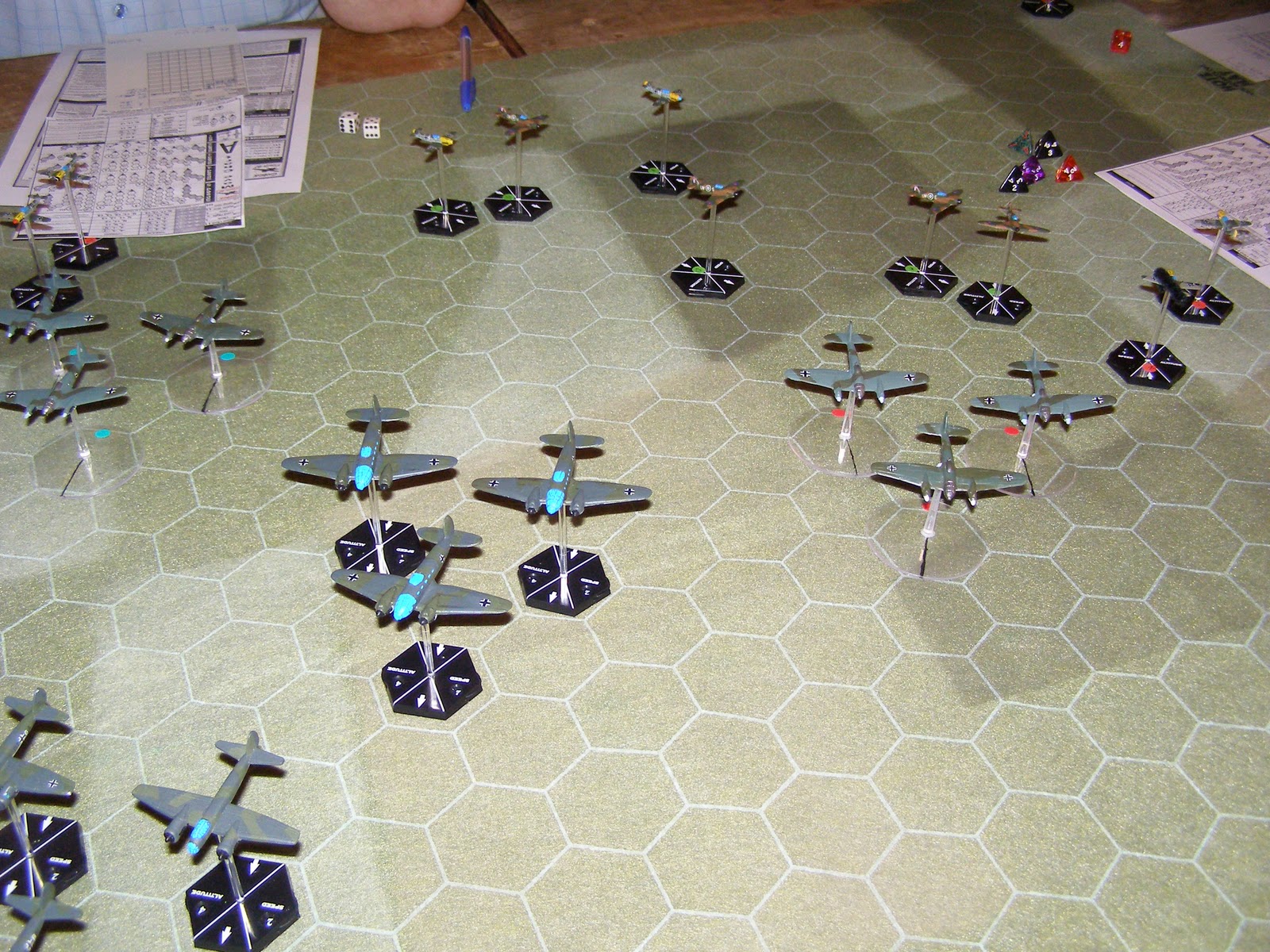
Although I didn't blog all the game reports I felt that the last one was deserving if for no other reason than the sheer number of aircraft on the table. For the start of the Blitz we managed to gather a mighty armada of 15 Heinkel He-111s and 6 Junkers Ju-88s being escorted by 8 Bf-109s grouped into rottes (2 planes). The RAF mustered 2 flights of 4 Hurricanes each and one of 4 Spitfires. The bombers were placed on table and then the players were invited to place their flights one after another alternating from German to British (or I should say Allied...we mustn't forget the Poles, Czechs, Commonwealth  and all the other pilots that gave everything and without them...well...who knows!). This lead to a very fluid situation from the outset with the RAF mingling with the Luftwaffe from the very start, which is what I desired due to the numbers of planes on table. Even a couple of turns of maneouvring would have eaten up time. I'll not give an accurate description of the game as I pretty much can't! With that many planes it's almost impossible to keep track of everything so I'll let the pictures tell the story (with the help of some captions!) :


The inital positions. You can see the RAF are mostly bouncing the bomber formation from behind.


The RAF make their first pass at the bombers as the fighter escort tries to get into position to make their kills.

Closer view of the action. A Heinkel has suffered engine damage  and has turned for home.

On the other side the fighter escort has tangled with the RAF allowing the bombers to slip away. There are two opposing aces in this dogfight and they each really wanted to chalk up the other as a victory!

More and more bombers suffer damage and are forced to ditch their bombs and turn for home, but RAF casualties are mounting.

A large portion of bombers have got away as the dogfight develops. A plucky green pilot sets off after them in his damaged Hurricane. Despite getting hit another couple of times his airframe avoids any more damage and he would damage 2 of the bombers forcing them to abandon their mission. This pilot was awarded the DFC.

The results of the game were 1 Heinkel shot down and 7 damaged for the loss of 4 RAF fighters and 1 damaged. One Bf-109 was shot down and another damaged. Two inexperienced Luftwaffe pilots were drawn too far into the enemy territory and would not make it back to France due to lack of fuel. So, all in it was an RAF victory, but not a big enough one to take the campaign which the Luftwaffe players shaded.

I had a good time running the campaign and coming up with the scenarios and I really hope that the players enjoyed the games and perhaps you enjoyed reading about them!
Related Posts Plugin for WordPress, Blogger...